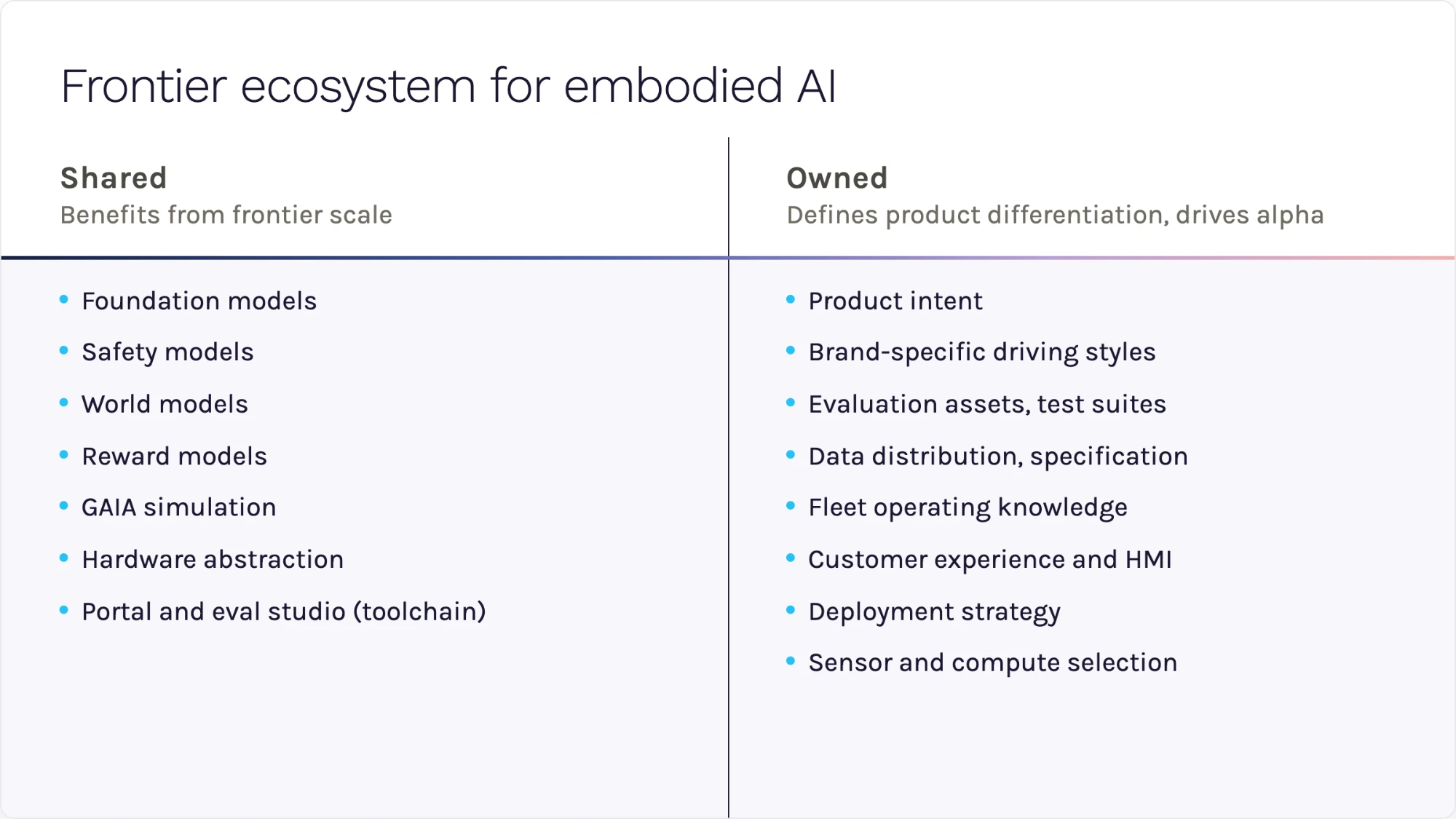
A frontier ecosystem for embodied AI
Over the past few weeks, I've been thinking about two essays from Alex Karp and Satya Nadella.
Both ask the same question from different directions: as foundation models become increasingly capable, where does long-term competitive advantage come from? Satya writes that every firm now has to build both human capital and token capital, and that the winners will be those who build a learning loop where the two compound together, rather than ceding that loop to a handful of frontier models. His test for whether a company has real sovereignty: can you swap out the generalist model underneath you without losing the "company veteran" expertise your systems have built up? Karp's version is more adversarial. Frontier labs, he argues, are quietly absorbing the proprietary data and process that used to make an enterprise defensible, then handing back a subscription.
Both land on the same conclusion: the model isn't the moat. The learning ecosystem around it is.
At the same time, we've been having a similar conversation with many of the automotive leaders we work with. The wording is different, but the concern is remarkably consistent.
Nobody is questioning whether an AI Driver will become part of the vehicle anymore. They assume it will. Instead, they're asking:
- How do we benefit from frontier AI without giving up control of what makes our products distinctive?
- How do we avoid rebuilding everything ourselves while also avoiding dependency on someone else's autonomy stack?
This is the same conversation just viewed through the lens of Embodied (or Physical) AI.
Wayve is enabling the world's largest manufacturers and fleets to bring intelligence to their robots, starting with consumer vehicles and robotaxis. This is an important mission. Physical industries make up the majority of the world's GDP and carry safety expectations no software-only business has ever had to meet.
There are well over a billion vehicles on the road today, and the way we see it, that's the first wave of the embodied AI transition.
Imagine trusting your personal car to take responsibility for driving on any road, anywhere in the world. This isn't the same as trusting an AI to generate a paragraph of text or lines of code. When an AI Driver makes a mistake, it isn't a bad answer. It's a physical trajectory executed by a two-ton vehicle. The consequences are fundamentally different. Safety, validation and governance become central to the product itself.
Frontier AI also enables completely new product experiences. But no single generic autonomy stack can support that diversity of products. What we consistently hear from our customers is a desire to retain design control so they can build the products they imagine.
I don't think the traditional build-versus-buy discussion captures this dilemma particularly well. Every automaker I speak with is wrestling with the same trade-off. Build everything yourself, and you'll struggle to keep pace with frontier AI. Buy a closed autonomy stack, and you risk outsourcing one of the defining parts of your product. Neither feels like the right answer.
The more interesting question is where to draw the boundary. What intelligence should continue improving through a shared frontier ecosystem? And what learning assets should remain under the manufacturer's control? I think this is becoming one of the defining strategic decisions in embodied AI.
Some intelligence benefits enormously from being shared. Frontier Embodied AI will only be reached by learning at a scale that goes beyond a single manufacturer's products. Foundation models, world models, reward models and driving models all benefit from frontier scale and will become the base that everyone builds upon.
But other capabilities become more valuable when they remain proprietary. Product intent, brand-specific driving behavior, evaluation suites, training and evaluation data, fleet operating knowledge and customer experience are what allow manufacturers to build products they genuinely own. These are the learning assets that compound over time as products evolve and customer understanding deepens.
In a frontier ecosystem for embodied AI, the opportunity is not to own every layer of the AI stack. It's to own the learning assets that differentiate your products while benefiting from a larger ecosystem that continually advances the underlying intelligence. Once you look at the problem through this lens, a number of design principles follow.
- Frame autonomy as an AI problem. Turn autonomy into a learning architecture that scales with data. Don't compromise the core learning architecture with brittle rules-based approaches. Focus on pure generalized intelligence with end-to-end deep learning. This is the foundation on which everything else below depends: without it, there's no learning loop to own in the first place. Critically, end-to-end learning applies to safety and simulation too, not just driving policies. Just like driving, embodied AI safety improves faster with learned representations than with anything hand-engineered.
- Decouple AI from architecture. Don't get locked into a single compute or sensor supply chain. Your AI assets should be agnostic to the compute, sensing, and hardware platform underneath them, so you keep strategic flexibility and reuse across future technology generations. This is your Embodied AI sovereignty test; you should be able to swap out the underlying platform without losing the intelligence you've built on top of it.
- Own your brand and customer experience. General driving intelligence will increasingly become shared, but the product experience shouldn't. Manufacturers know how their vehicles should feel, how they should behave and what their brand represents. AI shouldn't erase that differentiation. It should amplify it. At Wayve, we enable manufacturers to shape and optimize their data asset, provide supply chain flexibility for global markets, offer architectural flexibility to fit diverse product designs, and build custom interfaces and brand-specific driving behavior. This is the token capital Satya describes and the alpha Karp warns enterprises are giving away, but we believe manufacturers should continue to own.
- Aggregate data that can be understood and learned from. We've learned that performance scales not just with volume of data but also with the right diversity and selection. That requires the ability to edge-filter data, manipulate exabytes, and auto-label metadata to understand distribution and coverage. We work with our partners to shape and optimize their data asset to maximize learning signal for their product application — this is the raw material of the learning loop itself that you need to hold sovereign.
- Own your eval to measure what matters, beyond public benchmarks. In safety-critical, physical-world applications, measuring performance and continuously evolving your evaluation assets is what lets you get fast, confident feedback on new models. We let our customers define their own tests, upload product-specific scenarios, and access our frontier simulator, GAIA. This is the private eval Satya argues every firm needs: judging models against outcomes that matter to your business, instead of a generic leaderboard.
- Improve safety with industry-wide experience, without compromising iteration speed. Manufacturers should absolutely retain ownership of the learning assets that differentiate their products. But safety is one area where it makes sense to contribute data upstream where collective improvement supports the public good. This requires excellence in Embodied ML Operations with two learning loops running at different speeds: (1) a slower, powerful frontier model training loop learning from industry-wide experience to improve generalized driving behavior and safety for everyone, (2) a faster customer-controlled learning loop running within your own control for quick response to design changes or field issues.
Together, these strategies create a frontier ecosystem that compounds for every manufacturer and fleet that builds on it. The promise of frontier models should not be to push for generic products. It should be to enable superhuman capabilities with human design that allow brands to differentiate and compete, and consumers to enjoy new benefits.